What most visitors miss
Every guide sends you to the same places: Rotonde → Cours Mirabeau → terrace coffee → Cézanne's studio. It's beautiful, it's real — but Aix hides so much more. After years of welcoming travellers at the Cabanon, here are the recommendations we give quietly. The ones that never make it onto the tourist-office boards.
The 12 gems of Aix-en-Provence
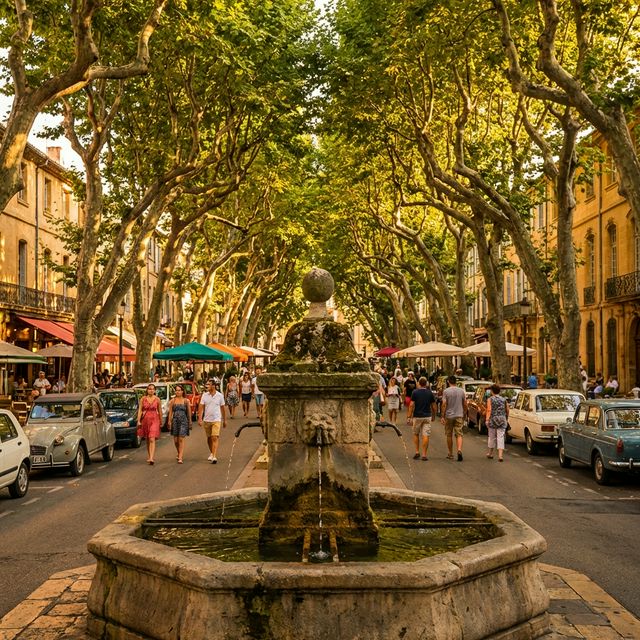
Almost everyone walks past it without knowing. The mossy fountain in the middle of the Cours — covered in green and gold deposits — runs warm water continuously. It is a natural thermal spring inherited from Roman times. The Romans founded Aix for these waters: Aquae Sextiae, "the waters of Sextius." Put your hand in. The water is warm.
★ Roman gemCézanne's studio on the Colline des Lauves has remained unchanged since his death in 1906. The visit is short (30–40 min) but exceptional if you arrive at opening time. The first tourist groups arrive around 10:30am. Before that, you are alone in the room where the last great Sainte-Victoire paintings were made. Online tickets recommended.
★ Alone in the studioNot the souvenir market. The one where local farmers and producers set up, Tuesday, Thursday and Saturday from 7am to 1pm. Hillside raspberries, aged goat's cheese, fresh figs, bulk olive oil, dried lavender baskets. Build your lunch picnic here — prices are direct from the grower.
★ The locals' marketThe cathedral is well known. Its cloister, barely at all. Accessible from the nave, free of charge, it dates from the 12th century: paired columns, capitals carved with rare precision. In late morning, when the light filters through the arcades, it is one of the quietest and most beautiful places in all of Provence. Most tourists leave without ever finding it.
★ Hidden treasureA 17th-century mansion built for the Duke of Vendôme, surrounded by formal French gardens that are almost deserted in the morning. The museum inside is modest but the gardens deserve 20 minutes of wandering — central fountain, clipped box hedges, Renaissance façade with sculpted atlantes. Very affordable entry, sometimes free.
★ Secret gardens4 hours return from the Barrage de Bimont car park. 360° views over all of Provence from the cross at 946m. The dam itself has an unexpected history: it was designed by François Zola — engineer and father of Émile — who used it to supply Aix with water. This hike doesn't appear in every guide, but it features in every memory of those who've done it.
Start before 8am in July–August. At the top, the heat can make the descent punishing after 11am.
The oldest confectionery in Aix, founded in 1874. Calissons are made here to the traditional recipe: Provençal almonds, candied melon, royal icing. You can visit and taste. These are not from the same world as the cardboard boxes sold at airports under the name "calissons d'Aix."
★ Est. 1874The part of Aix built in the 17th century to the plans of Archbishop Michel Mazarin (brother of the Cardinal). Regular street grid, town houses, the Fontaine des Quatre-Dauphins at its centre. Much quieter than the Vieil-Aix, almost nobody there in the morning. The Place des Quatre-Dauphins, with its four-dolphin fountain, is one of the most beautiful squares in France — and remains strangely little visited.
Le Cabanon d'Aix is 10 minutes by car from the centre. Private terrace, parking, peace and quiet. You get the best of both worlds: Aix at arm's reach, the pine forest on your return.
Check availability →Around the Place de Verdun and the Place des Prêcheurs, on Saturdays (sometimes Fridays). Moustiers ceramics, Provençal antique linen, faïence, santons, farmhouse furniture. Not a car-boot sale: specialist antique dealers who know every piece they sell. Even without buying, it is a window into the old Provence.
★ Local antiquesThe Cours Mirabeau is magnificent but its terraces charge tourist prices and are often full in summer. The Place des Prêcheurs, two minutes away on foot, is where the locals go. Shaded, overlooked by the Palais de Justice, the terraces are cheaper, the late-day light identical — and the atmosphere far more genuine.
★ Locals' terrace45 minutes from Aix. This perched village in the Alpilles, listed among "France's Most Beautiful Villages," is indeed packed between 11am and 5pm in summer. But after 6pm, when the coaches have gone, it takes on a completely different character. The ruins of the medieval castle dominate a sea of garrigue and olive trees — in the low evening light, the sight is in a class of its own.
Les Baux hosts "Les Carrières de Lumières": monumental projections inside former bauxite quarries. A show in its own right.
The same avenue everyone knows — but in silence. The thermal fountain faintly steaming in the cool morning air. The century-old plane trees. The 17th–18th century façades still in the cool shadow. The Café de la Rotonde not yet open. It is another city: the one 99% of tourists will never see. From Le Cabanon, you are there in 10 minutes at that hour.
★ The real AixAix can be very busy in high season. Museums (Cézanne's studio, Musée Granet) often fill up without advance booking. Plan visits before 10am or after 4pm to avoid queues — markets, the cloister, and the gardens remain accessible at any time.
What is the best season to visit Aix?
Aix is beautiful all year — it is a city of sunshine. But the best period according to locals is September: the tourists have gone, terraces are still open-air, markets are at their peak (figs, grapes, watermelon), and the late-day light on the Cours Mirabeau is something you need to see at least once.
April–May is also excellent: markets burst into life, gardens are in bloom, and temperatures allow hiking towards Sainte-Victoire without suffering in the heat.
Markets in bloom, perfect temperatures for hiking, few crowds.
Autumn produce, golden-hour light, terraces still out. The locals' favourite season.
Aix at its most lively, but crowds and heat. Start early, return late.
Christmas market, Carrières de Lumières at Les Baux, quiet and bright city.
Frequently asked questions about Aix-en-Provence
2 days are enough to see the essentials (Cours Mirabeau, markets, Cézanne's studio, Quartier Mazarin). Allow 3 days to add an excursion: Sainte-Victoire, Les Baux-de-Provence, or a day at the Calanques from Cassis. A well-organised weekend is ideal for a first visit.
Yes, many. The cloister of the Cathédrale Saint-Sauveur (accessible from the nave, free), the markets, the fountains, the gardens of the Pavillon de Vendôme (some days), a stroll through the Quartier Mazarin, hiking around the Barrage de Bimont. The city itself is a free show at any hour.
The city centre is entirely walkable. A car is useful for excursions: Sainte-Victoire (20 min), Les Baux-de-Provence (45 min), the Calanques (40 min). If you are staying outside the centre like at Le Cabanon d'Aix, a car lets you reach town in 10 minutes and explore the whole region freely.
Ideally, yes. The city is elegant, human-scale, with excellent restaurants, markets, and accessible nature. A well-designed couples' trip alternates town in the morning, nature in the afternoon, and returning to a quiet spot in the evening — in an intimate place rather than a city-centre hotel.